Construction jobsite security helps thwart thieves, protect property and keep projects and budgets on track.
Article Updated on: October 15, 2026
Construction site security is more important than ever. Rising material and labor costs are squeezing profit margins. Thin margins and tight timelines leave little room for downtime or budget hits caused by construction theft, vandalism or property damage. And few contractors or project owners can afford damage to their reputation.
Learning how to secure a construction site and how to prevent construction site theft benefits contractors large and small. From jobsite fencing to locking storage containers, here are six ways contractors can improve security for construction sites and protect their assets, schedules and bottom line.
1. Create physical barriers with temporary fences
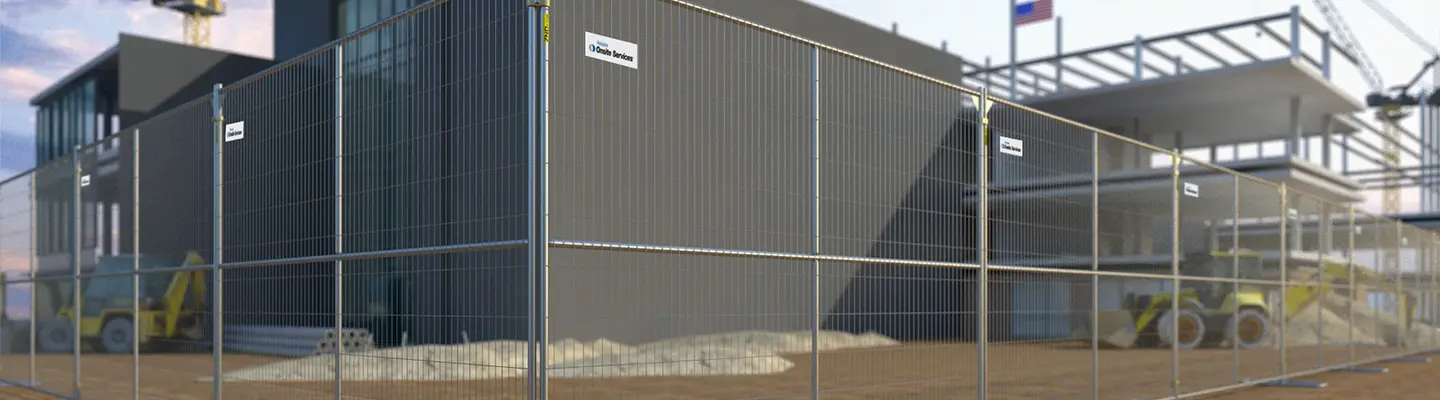
Temporary construction fences establish a well-defined jobsite perimeter and make it harder for trespassers to enter—and to leave with stolen goods in hand.
Anti-climb fence panels, supported by tube or peg stands, are easy to install and relocate as the jobsite footprint changes. Temporary fence panels are typically 6 feet tall or 8 feet tall, and 2-foot extension panels can be installed to increase the fence height for added security. For enhanced stability, fence stabilizers or base weights can be added to both sides of the fence.
Adding privacy screens, also called wind screens, minimizes unwanted attention to the jobsite and the items within it. A significant percentage of construction theft is opportunistic. Out of sight, out of mind.
2. Manage entry with gates and turnstiles
Fencing requires points of entry for pedestrians, vehicles and equipment. Controlling access at these points is critical to construction site theft prevention.
Rolling vehicle gates and sliding vehicle gates integrated with jobsite fencing allow owners to control access for cars, trucks and rolling equipment.
To deter pedestrian trespassers, anti-climb pedestrian gates can be installed and padlocked after hours and on holidays.
On mid- to large-size projects, modular smart turnstiles offer an innovative approach to access management. These turnstiles, which easily integrate with temporary fences, restrict access to authorized entrants. They also provide a searchable digital log of who entered and exited the site and when. To gain entry, authorized personnel place a smart ID badge issued by the project owner on the turnstile’s card reader.
3. Install jobsite security cameras for real-time visibility
Cameras mounted on perimeter fences, along with signs indicating that the site is under 24-hour surveillance, provide a visual deterrent to entry. Security cameras can capture perimeter or jobsite activity depending on placement. Most can send real-time motion-triggered alerts to security personnel, enabling them to respond immediately and potentially minimize the impact of a breach.
Infrared cameras can “see” in the dark for 24/7 surveillance. High-definition cameras capture clear footage that allows security personnel to identify license plates and facial features, increasing the chances of catching thieves after the fact.
The value of AI security cameras
AI-enabled cameras let contractors input business rules such as work hours and restricted zones, so the AI can better identify suspicious activity. AI can not only distinguish between people and vehicles but also tell the difference between a deer and a person, or a fence climber and a blowing tree branch, which reduces false alarms. Some AI cameras can be programmed to point in different directions based on the time of day.
Mobile surveillance cameras for specific jobsite zones
To keep watch over specific areas such as laydown yards and storage areas, contractors can rent trailer-mounted mobile security camera towers.
Towers available from United Rentals have two infrared HD cameras set on a mast that extends up to 20 feet. The cameras rotate 360 degrees and feature configurable recording. Because the solutions are solar powered, contractors can use them on jobsites where power is not readily available. The trailers can easily be towed to another location as the project progresses.
4. Fight construction equipment theft with geofencing
Heavy equipment that sits on a jobsite overnight or on weekends may be tempting for sophisticated thieves, kids looking to take the equipment for a joyride and even employees or subcontractors who want to “borrow” a loader or mini excavator for a personal project. Geofences create a virtual boundary around telematics-enabled equipment to help prevent construction equipment theft.
In a cloud-based fleet management system such as United Rentals’ Total Control®, contractors can draw a geofence and configure alerts that notify them if a piece of equipment leaves it.
The faster a contractor responds to stolen equipment, the better. If equipment isn’t found within 24 hours, the odds of recovery decrease dramatically.
5. Store valuable assets in storage containers
Storage containers are a simple but effective way to protect tools, materials such as lumber and copper, and small equipment—even skid steers—from thieves. Containers keep items out of view of the public and away from people on the jobsite who don’t need access.
Locking a storage container with a padlock is smart, but padlocks can be broken. Another option is renting a locking storage container. United Rental’s PV3 locking storage containers, available in multiple sizes, feature interior locking rods and solid brass locks with hardened steel pins. Solar-lit containers increase visibility in the early morning and late evening.
6. Layer solutions for maximum jobsite security
Each jobsite requires a custom security solution. Many jobsites benefit from a layered approach that uses multiple security measures working in concert.
For projects large or small, short term or long term, United Rentals can help customers create an integrated, scalable jobsite security system with the goal of reducing liability and safety risks and protecting profits and schedules.
Partnering with a single rental provider rather than juggling multiple vendors can improve security planning and reduce friction, so contractors can move on to other aspects of mobilization sooner and operate with greater peace of mind.
 Facebook
 X
 Linkedin
 Email
 Print
 Copy Link
 RSS Feed

