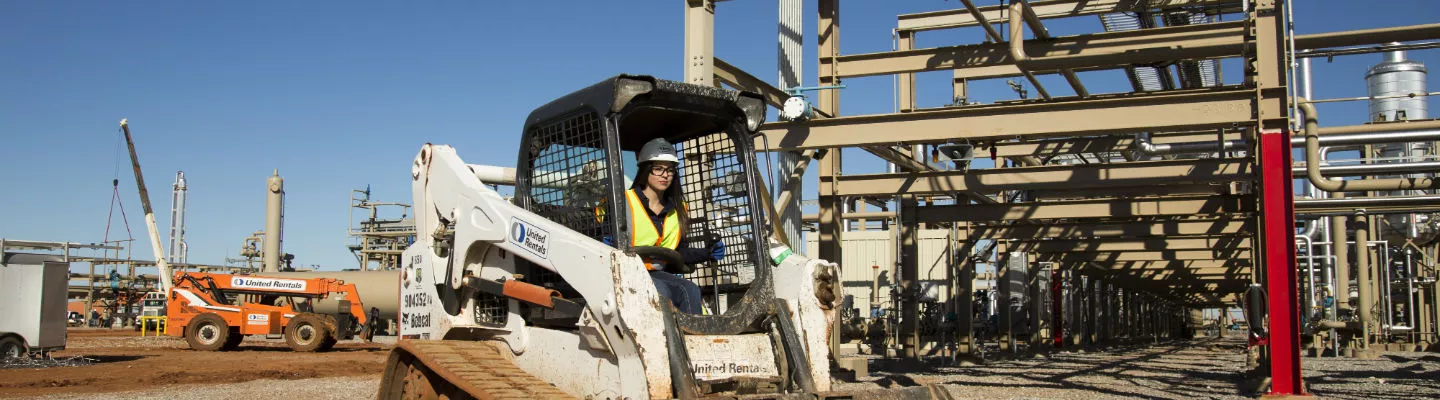
Learn about the different skid steer lift capacities, sizes, control types and attachment options to find the right skid steer for your project.
Article Updated on: September 24, 2026
On construction sites, farms and industrial plants, skid steer loaders are the little engines that could. What is a skid steer used for? A better question would be what isn’t it used for. Compact, maneuverable and able to “skid” around corners, skid steers are incredibly useful for digging, grading, leveling and even demolition, not to mention jobs like brush cleaning and snow removal. In short, they’re a must-have on construction sites.
How to choose the best skid steer loader for the job
Choosing the right machine will help you get the job done as efficiently and cost-effectively as possible. Here are some of the variables to consider.
Skid steer size and width
The size of your job and the size of the space you’ll be working in (as well as the spaces you’ll have to fit through to get there) will dictate the skid steer size and width you need. The sweet spot is a machine that fits where you need it to go and has enough horsepower and rated operating capacity (ROC) for the weight you plan to lift. The ROC, or the skid steer lift capacity, is half of the tipping load.
Skid steer ROCs range from around 700 pounds to more than 4,000 pounds. Don’t confuse the ROC with overall skid steer weight.
Frame Size | Rated Operating Capacity (ROC) | Operating Weight | Horsepower | Best For |
|---|---|---|---|---|
Small-frame | ~700 lbs | Under 5,000 lbs | Under 50 hp | Landscaping, minor interior demolition and tight spaces |
Medium-frame | 1,300 to 1,900 lbs | 5,000 to 6,000 lbs | 50 to 70 hp | Large-frame |
Landscaping and light to medium-duty backfilling and grading | 1,900 to 4,000+ lbs | Over 6,000 lbs | Over 70 hp | Grading, excavating, heavy-duty attachments and road building |
The sizes of skid steers available include:
- Small-frame skid steers, with an ROC of about 700 pounds, generally work well for landscaping, minor interior demolition work and jobs in tight spaces. These can fit through a walkthrough backyard gate and are popular for homeowner projects.
- Medium-frame skid steers, with an ROC of 1,300 to 1,900 pounds and an operating weight of 5,000 to 6,000 pounds, are the most common and can be used for a wide variety of jobs.
- Large-frame skid steers, which have a large bucket or blade and more horsepower, are used for moving significant quantities of gravel or bricks, for grading or excavating a large jobsite or for building a road. If you have the space, a larger machine can save you time on the job by moving material faster, with fewer trips. A large skid steer can often take the place of a full-size backhoe or wheel loader if there’s no room for those machines.
If the area has trees or structures that you’ll need to maneuver between, make sure the skid steer fits between them. In other words, if trees are 5 feet apart, make sure the skid steer width is less than 5 feet.
Lift type: How high do you need to lift?
Traditional skid steers are radial lift machines, designed to push, dig or otherwise move materials around but not lift them to any significant height. A radial lift skid steer may or may not be able to dump material into a dump truck, for example.
If you’ll need to lift materials, a vertical lift skid steer is the better bet. These provide more reach at full lift height. A general rule of thumb: If you’ll need to lift to eye level or above, consider a vertical lift skid steer.
Terrain considerations: Wheeled vs. tracked
Deciding between a tracked vs. wheeled skid steer comes down to the surface and terrain.
Wheeled skid steers travel fast over level, hard surfaces such as asphalt, concrete or hard-packed dirt. They’re also better on landscaped surfaces, which tracked skid steers can rip up.
For rough, uneven or muddy surfaces, you’ll want a tracked skid steer, also known as a compact track loader. These have a broader weight distribution and therefore lower weight transfer to the ground. They can travel easily over loose gravel, sand or snow, are more stable on slopes and won’t compact the ground. They do need more maintenance and cleaning than wheeled skid steers, and they cost more.
Controls: Standard vs. joystick
Traditional skid steers are operated via hand levers and foot pedals, often called standard controls, but manufacturers have added joystick controls that rely heavily on wrist and hand movements.
Machines with either style of control system are commonly available because operator preferences vary.
Attachment compatibility
With the right attachment, a skid steer can be used to perform countless tasks. But not every attachment will work with every skid steer.
Some important things to note about skid steer attachments include:
- Skid steer attachments fit into the skid steer’s arm. Many attachments call for a skid steer with the higher horsepower (over 70) that comes with a large frame and an ROC of at least 1,800 to 2,000.
- A high-flow hydraulic system will provide more flow to the attachment compared with a standard hydraulic system, letting you get the job done faster. Because a high-flow hydraulics system won’t usually be operating at full capacity, the machine is likely to experience less downtime.
- Smaller skid steers (less than 50 hp) typically have a standard hydraulics system and support commonly used attachments, such as blades, breakers, buckets, forks and grapples.
- Medium-sized machines (50 to 80 hp) can support those attachments and more, including some that require more horsepower, such as augers and saws.
- Larger machines (more than 80 hp) can power the most heavy-duty attachments, such as cold planers, snow blowers, trenchers, augers, mulchers and chipper/shredders.
A good rental equipment provider will talk you through these considerations and advise on the size and type of machine you need and any attachments that could help you do the job more efficiently.
 Facebook
 X
 Linkedin
 Email
 Print
 Copy Link
 RSS Feed

