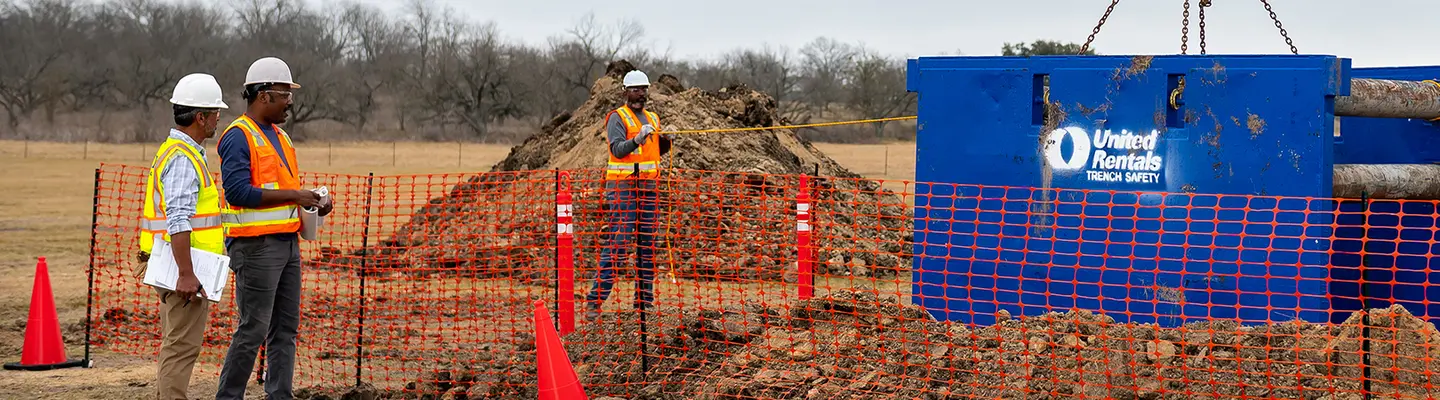
Properly classifying soil is critical to choosing an appropriate trench protective system.
Understanding the three types of soil OSHA recognizes is one of the first steps to performing safer trench and excavation work.
Each OSHA soil type behaves differently and influences the trench protective system required if the trench is 5 feet or deeper. Misclassifying soil is an all too common mistake, and it can lead to costly delays and even a potentially deadly trench collapse.
Below is an overview of Type A, B and C soil, as well as stable rock, which OSHA recognizes as a fourth excavation soil type, and C-60 soil, a classification used by manufacturers.
First, an explanation of granular and cohesive soils. One of the factors that determine the soil type—and the strength and stability of the soil—is how cohesive or granular the soil is. Cohesive soils have smaller particles that bind tightly together. They’re hard to break up when dry and hold their shape when moist. Granular soils are made of larger particles that don’t stick together easily. They have no cohesive strength, and when they are dry, they crumble easily when squeezed.
Type A soil: The most stable
Type A soil is the most stable type. It has an unconfined compressive strength of 1.5 tons per square foot (tsf) or greater, which means it’s firm. It’s also highly cohesive. It can never be granular.
Type A soils exert from 1 pound per square foot (PSF) to 25 PSF per foot of depth.
Soil cannot be considered Type A in a number of situations. The three most common factors that disqualify soil as Type A are:
- Is fissured (has cracks or breaks)
- Is subjected to vibration, such as from heavy traffic or pile driving
- Was previously disturbed, no matter how long ago
Refer to OSHA 1926 Subpart P Appendix A for more detail on all soil types.
Potential examples of Type A soil: Clay, silty clay, sandy clay and clay loam.
Expert insight on Type A soil
Type A soil is ideal to work in, but it rarely if ever exists in the real world. One reason is that the soil can’t ever have been disturbed, even if it was decades ago. Another reason: “With some soils, such as caliche and hardpan, once you start to dig, you're going to end up with cracks,” said Eric Partenheimer, customer training specialist at United Rentals.
“Really, there is no situation where you are going to be working in dirt that is not fissured, not subject to vibration and has not been previously disturbed,” added Rick Plocinski, also a customer training specialist at United Rentals.
Type B soil: Less stable, with medium compressive strength
Type B soil is less stable than Type A soil, with a medium compressive strength. It’s allowed to have some properties that would disqualify it as type A soil. Cohesive type B soil has an unconfined compressive strength greater than 0.5 tsf but less than 1.5 tsf. It can:
- Be granular cohesionless soil, including angular gravel and silt
- Have been previously disturbed
- Be fissured or subject to vibration, as long as it meets the unconfined compressive strength or cementation requirements of type A soil
- Be dry rock that is not stable
- Type B soils exert from 26 pounds per square foot (PSF) to 45 PSF laterally.
Potential examples of Type B soil: Angular gravel, silt, silt loam and sandy loam.
Expert insight on Type B soil
“People get a false sense of security with B soil. They automatically think it's a good, cohesive soil. But not all B soils are cohesive,” said Partenheimer.
“Angular gravel like crushed rock, for instance, will be considered a B soil if it’s compressed down enough. It will bind together because of the edges,” Partenheimer continued. “But once we start to dig and we loosen those compression factors, it becomes a less cohesive B. And per the OSHA standard, you can only bench in B and cohesive or better.“
Even some highly granular soils may appear cohesive when they aren’t. Think about building a sandcastle. Adding just the right amount of water allows the sand to stand, but as soon as the water drains or evaporates, the sandcastle walls will fail.
Type C soil: The least cohesive and least stable
Type C soil is the least stable soil type. It’s porous and easily disturbed. If a person presses the point of their thumb into the soil, the thumb will easily penetrate the soil. These properties limit which protective systems can be used and how.
Type C soil:
- Has an unconfined compressive strength of 0.5 tsf or less
- Can include loose granular material
- Can include submerged soil or soil with water freely seeping from it
- Can include submerged rock that is not stable
Type C soils exert from 46 PSF to 80 PSF per foot of depth laterally.
One of the primary differences between granular Type B and Type C soil is the shape of the grains. More rounded grains tend toward type C soil. They are common in soils exposed to water. Rough and angular grains are generally more stable due to friction and tend toward type B soil.
Potential examples of Type C soil: Gravel, sand, loamy sand, submerged soil, unstable submerged rock.
Expert insight on Type C soil
Contractors should treat all soil as Type C soil unless they can prove otherwise.
“Assume the worst-case scenario,” said Plocinski. “Proper soil testing using a series of visual and manual tests is necessary to determine that the soil is B or better.”
Many contractors assume Type C soil but proceed to bench the excavation. Benching is not permitted in Type C soil.
“These contractors are setting themselves up for failure or citation,” said Plocinski.
C-60 soil: Between type B and type C (and not an OSHA designation)
Manufacturers calculate depth ratings for their equipment largely based on the soil type the system will be used in. Weak soil (Type C) limits the allowable depth. But not all Type C soil is the same.
Each OSHA soil type has a defined range of side pressure, called lateral equivalent fluid pressure. Type C soils have the widest range, from 46 to 80 PSF for every foot of depth. A soil that pushes as much as 80 PSF is likely flowing, meaning it moves or sloughs easily.
Since not all type C soils behave that way, engineers introduced a category called C-60 to represent soil that exerts about 60 PSF. They defined this soil type and created equipment depth charts for it.
This matters because aluminum hydraulic vertical shores cannot be used in very weak, flowing type C (80 PSF) soil. Without the C-60 category, vertical shores would only be allowed in type A or B soils, but with it, they can also be used in C-60 conditions.
OSHA doesn’t include Class C-60 in its soil types, but as long as contractors closely follow the manufacturer’s tabulated data, they will meet OSHA excavation requirements.
Type C soil can be sloped, but it can never be benched, even if it’s C-60 soil. “There is no C-60 soil in sloping and benching,” said Partenheimer. “It’s Type C soil at that point.”
Stable rock
OSHA defines solid rock as “a natural solid mineral matter that can be excavated with vertical sides and remain intact while exposed.” In theory, excavations in stable rock do not require a protective system.
In practice, however, stable rock is rare at excavation sites. In most cases, using force to dig or blast the rock will create fissures. When the rock is fissured, it must be classed as a Type B soil. Excavating unstable rock is very difficult, but that difficulty does not mean the rock is stable.
Stable rock examples: Unfissured granite and sandstone.
How soil type influences trench protective system choice and design
The type of soil impacts the choice and design of trench protective systems in many ways. For example:
Choice of system: Sloping, benching, shoring, and shielding are the four types of protective systems. Benching isn’t legally permitted with Type C soil.
- Slope angles: In sloped excavations, stronger, more cohesive soils allow for steeper slopes. For example, in Type A soil, the maximum allowable slope ratio is ¾:1 (horizontal to vertical), or 53°.
- Bench specifications: In benched excavations, the soil type dictates the maximum allowable height of the benches.
- Depth rating: The soil type dictates the depth at which certain types of protective systems, such as trench boxes, can be used. In poorer soil, the depth rating decreases.
- Spacing of shoring and shielding equipment: In hydraulic shoring, for example, poorer soils may require more hydraulic struts placed closer together.
How the designated competent person classifies soil
Classifying excavation soil types must be done by a designated competent person. They should be trained in, and have demonstrated knowledge of, soil analysis, protective system options and the requirements of the OSHA excavation standard.
To classify soil, they perform both visual analysis and manual testing. They must reevaluate the soil conditions at the start of each shift and whenever conditions have changed.
United Rentals’ course Excavation Safety Training for Competent Persons includes soil classification as one of the topics covered.
The value of professional guidance when choosing a trench protective system
Some excavation sites present complex challenges, including sites that:
- Contain more than one soil type
- Have a high water table
- Have surcharge loads on the soil from adjacent structures or equipment
The United Rentals Trench Safety team has deep experience in recommending and designing trench protective systems in many conditions. They are available to help contractors choose the most secure excavation method based on the soil type and other factors. United Rentals also offers custom-engineered shoring designs for excavations that require stamped drawings from a registered professional engineer.
 Facebook
 X
 Linkedin
 Email
 Print
 Copy Link
 RSS Feed
